How to Choose the Right ATS Switch for Your Needs?
Choosing the right ats switch is not a catalog exercise. It is a decision about what must stay powered, how quickly backup should connect, and what your installation can safely support. A hospital, a small office, and a remote pump station do not face the same risks. Their loads, generators, and operating conditions differ.
Electrical educator Mike Holt is known for practical instruction on electrical systems. A useful paraphrase of that approach is: “Match electrical equipment to the real installation, not just the headline rating.” This is a paraphrase, not a verbatim quotation. It captures an important starting point: check the load current, voltage, phase, source capacity, and switching method before comparing models. Also consider whether the switch is intended for emergency, standby, or legally required loads under applicable local codes. Qualified professionals should verify the design.
Details matter. A 400-amp rating may look generous, but it does not prove the unit suits your generator or available fault current. Think about the enclosure, indoor or outdoor location, service access, and how often the system may transfer. Manual or automatic? That choice changes cost and response.
There is no perfect model for every site. Even a careful checklist can miss a real-world constraint, such as a cramped electrical room or a generator that starts slowly. That deserves a second look. This guide will help you compare the main ATS features, ask better supplier questions, and narrow your options without treating one specification as the whole answer.
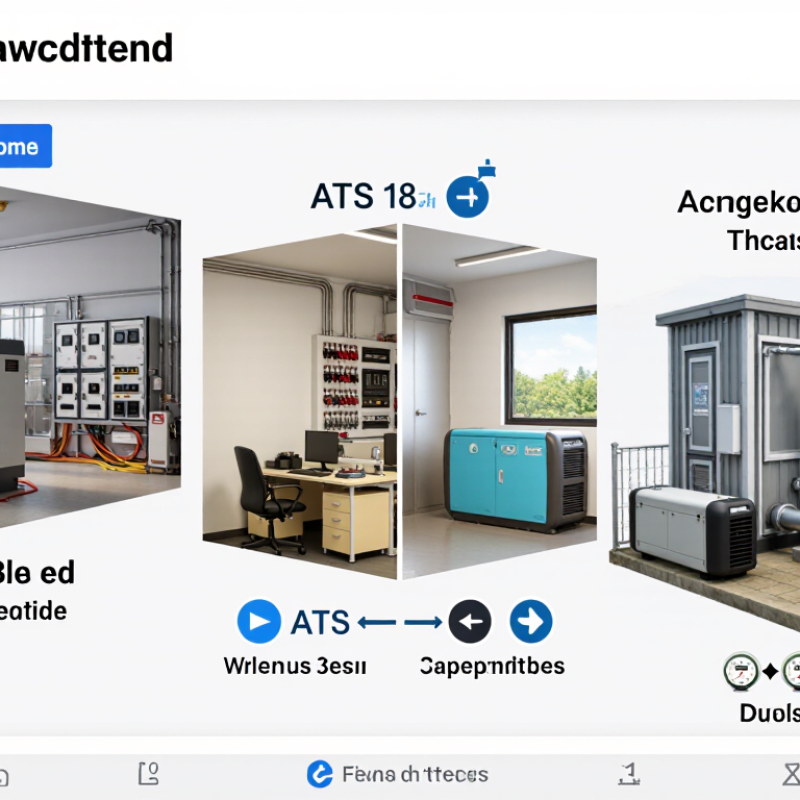
Define Load, Voltage, Phase, and Amperage Requirements for the ATS
Before selecting an ATS, list the equipment it must support: essential lighting, refrigeration, pumps, servers, or an entire building. Add each load’s running current, then account for motor starting surges and planned expansion. A pump may draw far more current during startup than while running. Do not size the switch from a generator’s headline kilowatt rating alone; verify the ATS’s continuous ampere rating and short-circuit withstand rating with a qualified electrical professional. Applicable electrical codes may require extra capacity for continuous loads.
Match voltage and phase on both power sources and the connected load. A 208Y/120-volt, three-phase panel cannot be treated as interchangeable with a 480Y/277-volt system. Confirm frequency, neutral arrangement, and whether a switched neutral is needed for the installation’s grounding design. Then check the load’s measured or documented demand, not just its theoretical maximum. That distinction can be messy. Uptime Institute’s 2024 Annual Outage Analysis reported that 54% of respondents said their most recent significant outage cost more than $100,000. That finding is not an ATS sizing rule, but it shows why critical loads deserve careful review. Have an electrician verify the source ratings, load profile, and installation conditions before specifying the switch.
Match Transfer Time to NFPA 110’s 10-Second Type 10 Requirement
When choosing an automatic transfer switch (ATS), treat NFPA 110’s Type 10 requirement as a system deadline, not a switch-only rating. The 2022 edition calls for emergency power to reach the load within 10 seconds after normal power fails. That interval includes failure detection, generator start, voltage and frequency stabilization, transfer, and load acceptance. Every second matters.
An ATS with a fast transfer time cannot make up for a slow-starting generator. Check the complete sequence under realistic conditions, including the loads that start automatically. Uptime Institute’s 2024 Annual Outage Analysis found that 54% of respondents said their most recent significant outage cost more than $100,000. That figure is not specific to ATS failures, but it shows why timing deserves careful verification. Test it under load.
Ask for documented commissioning results, not just catalog transfer times. Confirm how the equipment behaves when the generator starts slowly or the first transfer attempt fails. A witnessed test can reveal delays that look minor on paper. It can also expose assumptions about load sequencing that need another look. Don’t guess. A Type 10 target is met by the whole emergency power system, and a few seconds can disappear quickly.
Select Open, Delayed, or Closed Transition to Suit the Load
An ATS choice begins with the load’s behavior during a transfer. The load decides. Open transition disconnects one source before connecting the other, creating a brief interruption. For ordinary lighting, heating, and equipment that can tolerate a short pause, this straightforward arrangement may be sufficient. Check whether controls or contactors could drop out when power disappears, even briefly.
Delayed transition also breaks the connection before making the next one, but it adds a pause. That waiting period can let residual voltage from rotating motors decay before they receive power from the alternate source. This can reduce electrical and mechanical stress in some installations. The delay must suit the equipment; too short may not help, while too long can disrupt operations. There is a trade-off.
Closed transition connects the incoming source before disconnecting the outgoing source, minimizing interruption. It can suit sensitive processes, but only when the sources can be synchronized and the transfer equipment is designed for brief parallel operation. Confirm the system’s operating conditions with a qualified electrical professional. A closed transition is not automatically the best choice for every critical load. Sometimes a properly sized UPS is still needed. That distinction is easy to overlook. Review load data, motor starting behavior, and acceptable downtime before selecting a transition type.
Check UL 1008 or IEC 60947-6-1 Compliance and Fault-Current Ratings
How to Choose the Right ATS Switch for Your Needs?
Check UL 1008 or IEC 60947-6-1 Compliance and Fault-Current Ratings
An automatic transfer switch must match the electrical system it serves. Check whether the unit is evaluated to UL 1008 or IEC 60947-6-1, as applicable to your project. Confirm the exact model and configuration in its documentation; a general standard reference is not enough. Requirements can differ by market and installation, so ask a qualified electrical professional to review the selection.
Fault-current ratings matter just as much. Compare the switch’s rating with the available short-circuit current at its installation point, and check which upstream protective device the rating assumes. A rating may depend on a specific fuse or circuit breaker combination. Do not compare numbers without checking test conditions and coordination details. That small omission can lead to a poor selection. I have seen specifications make this easy to miss.
Tips: Read the nameplate and technical sheet together. Verify the voltage, current, pole count, transfer type, and fault-current rating. Ask the supplier for supporting test documentation if a value is unclear. Then have the final choice checked against the site’s one-line diagram and protection study. Safety margins should be deliberate, not guessed.
How to Choose the Right ATS Switch for Your Needs?
Check UL 1008 or IEC 60947-6-1 compliance and verify the fault-current rating for your installation.
These are illustrative system fault-current reference levels, not universal ATS ratings. Have the available fault current calculated at the installation, then confirm the ATS rating at the system voltage and with the specified upstream protective device. Check the applicable UL 1008 or IEC 60947-6-1 documentation and tested configuration before selection.