Why Choose Wood Strip Wall Panels for Your Project?
A Wood Strip Wall can change the character of a room without a major renovation. Narrow timber slats add rhythm, texture, and a sense of warmth to otherwise plain surfaces. In a home office, they can frame a desk; in a living room, they can give the wall behind a sofa more depth. The effect depends on details. Slat width, spacing, wood tone, and the color behind the panels all influence how the finished wall looks.
Looks matter, but so does installation. A level starting line and consistent spacing help the panels appear intentional, while uneven walls may require preparation before fitting. Some products include a backing designed to reduce reflected sound, though results vary with the room and the complete wall assembly. Check the manufacturer’s specifications rather than assuming every panel provides the same acoustic benefit. Also consider cleaning, edge finishing, and access to outlets before choosing a layout.
Small choices add up. Wood Strip Wall panels may suit projects seeking a contemporary, natural finish, but they are not ideal for every space or budget. Timber can vary in color and grain, and samples may look different under your room’s lighting. That is worth checking in person. This guide explores the practical benefits, design options, installation considerations, and limitations to weigh before selecting panels for your project.
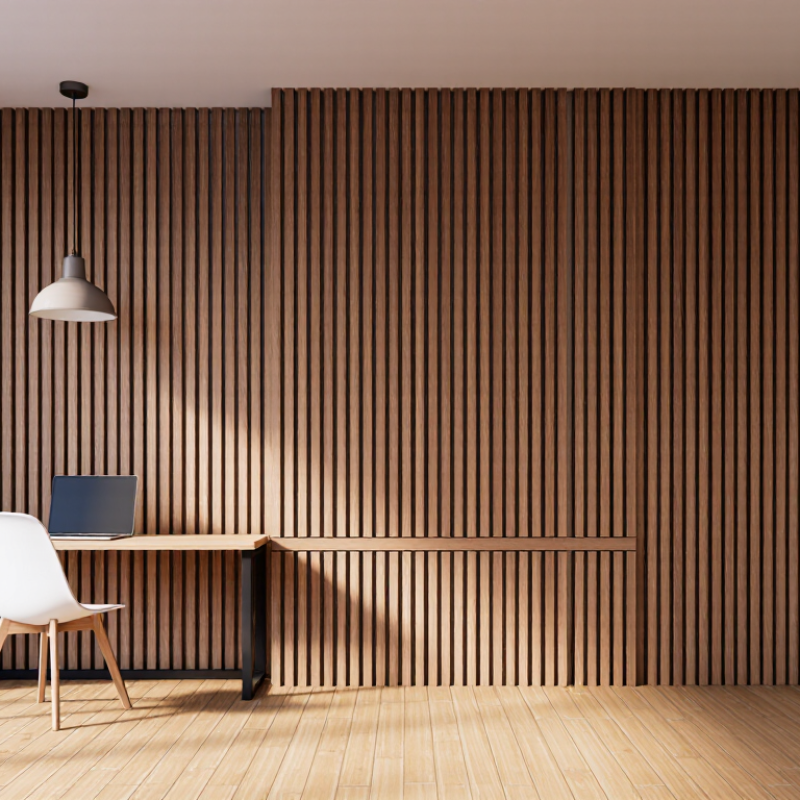
What Wood Strip Wall Panels Are and How They Are Made
Wood strip wall panels are made from narrow, elongated pieces of timber arranged in a repeated pattern. The strips may be solid wood, veneered engineered wood, or another wood-based material, depending on the design and budget. A backing board or support rails hold the strips in place, while small gaps create the panel’s linear appearance. Some products use a felt backing, but that does not automatically make a panel soundproof.
Manufacturing usually begins with selecting and drying the wood to help limit movement after installation. The material is cut into strips, milled to consistent dimensions, sanded, and finished with oil, lacquer, or another coating. Strips are then secured to a backing or prepared for mounting on wall battens. Details matter: uneven spacing, rough edges, or a poorly prepared wall can make the lines look visibly crooked. Wood also responds to changes in humidity, so panels need appropriate acclimation and installation clearance. The pattern may look crisp on a sample yet feel busy across a full wall; a small mock-up can reveal that.
Tip: Check strip width, gap size, finish, and backing before ordering. Compare a sample in the room’s actual light, and confirm that the wall can support the panel system.
How Their Structure Affects Appearance and Performance
Why Choose Wood Strip Wall Panels for Your Project?
How Their Structure Affects Appearance and Performance
Wood strip panels get their character from the spacing, depth, and alignment of each strip. Narrow strips placed close together create a fine, steady rhythm. Wider gaps cast stronger shadows and make the wall feel more textured. The backing matters, too. Panels fixed to felt or another acoustic layer may help reduce echo, but results depend on the room and installation. The strips alone are not soundproofing.
Structure also affects stability. Solid wood can expand or contract as humidity changes, while engineered cores may move less. Neither option is automatically right for every room. Check the product’s construction and installation guidance, and leave suitable expansion space where required. A flat, dry wall and secure fixings help prevent uneven lines or loose sections. In damp spaces, confirm that the chosen material is suitable. A flawless pattern can still feel too formal; sometimes the room needs more contrast. I would test a sample in the actual light before committing.
Tips: Hold a sample against the wall at different times of day. Check strip spacing, shadow depth, and edge details—not just the wood color.
Why Choose Wood Strip Wall Panels for Your Project? — How Their Structure Affects Appearance and Performance
| Panel structure | Typical construction | Visual effect | Performance considerations | Best suited to |
| Solid wood strips on acoustic felt | Individual timber slats fixed to a felt backing; the gaps expose the backing. | Natural grain and color variation give the wall a distinctive, tactile appearance. | Felt can absorb some reflected sound. Results depend on the felt, slat spacing, wall cavity, and installation. Solid wood can change dimensions as humidity changes. | Living spaces, offices, and other dry interior areas where natural wood character is desired. |
| Veneered MDF strips on acoustic felt | MDF slats with a real-wood veneer, attached to a felt backing. | More consistent color and grain than many solid-wood layouts, while retaining a real-wood surface. | The engineered core provides a uniform base; standard MDF is still vulnerable to swelling if exposed to moisture. Acoustic performance depends on the complete wall build-up. | Projects seeking a coordinated wood look and a regular slat layout in dry interiors. |
| Strips mounted on battens with an air cavity | Slats are fixed to horizontal or vertical support battens, leaving a space behind the panel. | Creates pronounced shadow lines and a stronger sense of depth than a flat-backed panel. | The cavity can accommodate services and may affect sound behavior. A cavity alone does not guarantee sound absorption; backing materials and construction matter. | Feature walls and projects that need space for wiring or a deeper architectural finish. |
| Slats fixed to a rigid sheet backing | Wood or veneered strips are attached to a continuous board rather than an open felt backing. | Produces a flatter, more continuous wall finish with controlled spacing and alignment. | The backing supports the strips, but a solid sheet generally does not provide the same exposed porous surface as acoustic felt. Panel weight and fixing requirements depend on materials and dimensions. | Installations prioritizing a firm, even surface over an open-backed acoustic design. |
Note: Construction, wood species, finish, slat spacing, and backing vary by product. Confirm moisture limits, fire classification, fixing method, and acoustic test data for the specific panel and project conditions.
Key Benefits for Interior Spaces
Wood strip wall panels add rhythm, warmth, and visible texture without taking up floor space. In a narrow hallway, vertical strips can draw the eye upward; in a lounge, pale wood tones soften hard surfaces. Slatted layouts also break up broad, blank walls and create a layered backdrop for lighting.
Panels can conceal minor surface irregularities and, where the assembly allows, hide cables in a service cavity. They may also help manage room sound, but performance depends on the backing, gaps, and insulation—not appearance alone. The 2015 Human Spaces report surveyed 7,600 workers across 16 countries. It associated natural elements in workplaces with 15% higher reported wellbeing, 6% higher productivity, and 15% higher creativity. These are reported associations, not proof that wood panels cause those outcomes. Still, wood is not magic. Finish, dusting, moisture exposure, and edge details affect how panels age.
Tips: Request details on the panel core, finish, and installation gap. Test a sample under your room’s lighting; the color can look quite different at home. Check cleaning needs before choosing a deep-grooved profile.
Common Applications Across Different Project Types
Wood strip wall panels work well in living rooms, where vertical lines can make a low ceiling feel taller. Behind a sofa or television, they add texture without requiring a full-room installation. A small sample helps reveal how the finish changes in morning and evening light. Details matter. In bedrooms, panels can frame a headboard, but leave access to outlets and switches. Wood may also respond to changes in humidity, so stable indoor conditions and suitable installation gaps are important.
Offices use slatted walls to define meeting areas or soften the look of reception spaces. In cafés and hotel lobbies, panels can bring warmth to hard surfaces such as glass, tile, and concrete. Some systems include an acoustic backing that can reduce echo, though they do not make a room soundproof. Not everywhere. In busy commercial settings, check cleaning needs, impact resistance, and applicable fire requirements before choosing a finish. One easy-to-miss issue is lighting: narrow gaps can create strong shadows, which may look uneven on a long wall. A mock-up on site is useful, even when the drawings look convincing.
Why Choose Wood Strip Wall Panels for Your Project?
Common applications across different project types
Wood strip panels are commonly used as decorative wall finishes and, when paired with an appropriate acoustic backing, can help manage sound reflections. The 1–5 ratings are a qualitative comparison of typical use-case fit, not measured performance data. Suitability depends on the panel system, room design, and project requirements.
Factors to Consider When Selecting Wood Strip Wall Panels
Choosing wood strip wall panels starts with the room, not the sample board. Measure wall height, width, outlets, doors, and trim before deciding strip width or spacing. Narrow strips can make a small room feel busier; wider gaps reveal more backing and change the visual rhythm. Hold samples upright in the actual light. Oak can look warm at noon and unexpectedly gray under cool LEDs.
Check the wall substrate and room conditions. Panels need a flat, secure surface, while kitchens, entryways, and damp rooms may require suitable finishes and careful ventilation. Ask for panel dimensions, core materials, cleaning guidance, and relevant fire-performance documentation for the intended space. For sound control, confirm whether the system includes an acoustic backing; wood strips alone do not guarantee quieter rooms. Installation details matter. Plan for corners, switches, expansion gaps, and concealed fixings before ordering. A few millimeters can show across a long wall. The darkest finish may seem ideal on a small sample, but dust and scratches can stand out. Compare samples against flooring and furniture. Some choices only become obvious after installation.