Skip to content
Menu Close

Why Choose an Axial Piston Pump?

An Axial Piston Pump is often chosen when a machine needs high pressure, precise flow control, and dependable performance in a compact package. You can see the difference in a mobile excavator: the pump must respond as the operator moves a control lever, then deliver useful power without wasting fuel when demand falls. That matters.

Hydraulic-control author John Watton’s published work offers a useful design lesson. Paraphrased, it is this: “Match pump behavior to the system’s real load, not just its peak rating.” That is not a verbatim quotation. It captures why pump selection should consider operating pressure, speed, fluid condition, control type, and duty cycle together. A unit sized only for a headline pressure may feel sluggish, run hot, or consume more power than needed.

Axial piston designs are not automatically the best choice. They can offer variable displacement and efficient operation, but they also require careful installation, clean hydraulic fluid, and maintenance suited to their working conditions. A small contamination problem can become an expensive repair. The practical question is not simply whether the pump is powerful. It is whether its output, controls, and service demands fit the machine over years of use. The sections ahead examine where these pumps excel, what trade-offs deserve attention, and how to judge a model against real operating needs.
Why Choose an Axial Piston Pump?

How an Axial Piston Pump Works

Why Choose an Axial Piston Pump?
How an Axial Piston Pump Works

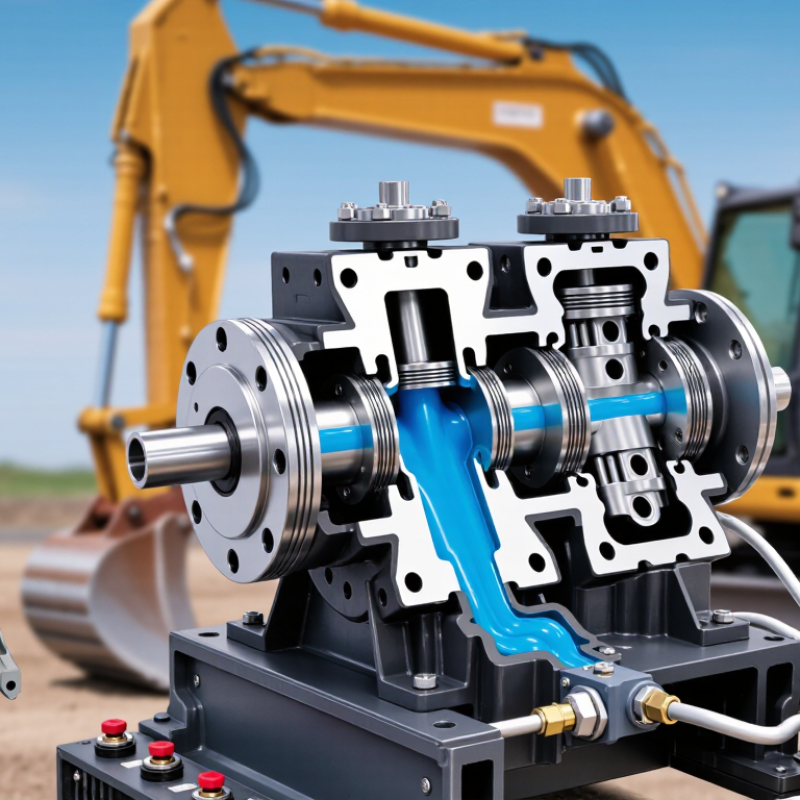
An axial piston pump turns shaft rotation into hydraulic flow. Inside, pistons sit parallel to the drive shaft in a rotating cylinder block. Their slipper ends travel across an angled swash plate. As each piston retracts, its chamber expands and draws in oil. As it advances, chamber volume shrinks and oil moves toward the outlet. Simple in principle. The swash plate angle sets piston stroke, so changing that angle changes displacement and flow. In a variable-displacement design, a control mechanism adjusts the angle while the pump runs.

Consider a 50 cm³-per-revolution pump turning at 1,500 rpm: its ideal flow is 75 L/min. That is a calculation, not a field guarantee; leakage and oil temperature reduce delivered flow. ISO 4409:2019 provides a steady-state test framework for positive-displacement pump performance, including flow, pressure, speed, torque, and temperature. The system’s load determines operating pressure, not displacement alone. Not quite so neat. Poor inlet conditions, contaminated oil, or excessive speed can undermine performance, and a smooth sound does not prove healthy operation. When assessing a pump, compare measured output with its rated conditions and inspect the oil, inlet line, and control response.

Why Choose an Axial Piston Pump? — How an Axial Piston Pump Works

Dimension How It Works Practical Benefit Typical Consideration
Pumping principle A rotating cylinder block contains pistons arranged parallel to its central shaft. As the block turns, the pistons move in and out of their bores, drawing fluid in and discharging it through separate ports. Produces a steady flow from a compact rotary design. Accurate port timing and clean hydraulic fluid help limit wear and internal leakage.
Swash-plate mechanism In a swash-plate design, the angled plate causes the pistons to reciprocate as the cylinder block rotates. Changing the plate angle changes piston stroke and pump displacement. Variable-displacement versions can adjust flow to match system demand. Not all axial piston pumps are variable displacement; some have a fixed displacement.
Bent-axis mechanism In a bent-axis design, the drive shaft and cylinder block are set at an angle. This geometry drives the pistons through their strokes as the assembly rotates. Offers another established configuration for high-pressure hydraulic service. Construction, size, speed limits, and performance depend on the specific design.
Flow and displacement Theoretical flow is determined by displacement per revolution multiplied by rotational speed. Actual flow is lower because of volumetric losses. Displacement and speed provide a practical way to estimate pump flow. Actual output varies with pressure, fluid viscosity, temperature, wear, and pump efficiency.
Pressure capability The pistons deliver fluid into a pressurized hydraulic circuit, while the pump’s structure and components withstand the resulting loads. Axial piston pumps are commonly selected for demanding, high-pressure hydraulic systems. Permitted continuous and peak pressures are model-specific; use the manufacturer’s ratings for the selected pump.
Flow control A compensator or other control mechanism can change displacement in response to system conditions, depending on the pump design. Can reduce unnecessary flow and help match output to changing actuator requirements. Control response and available control options vary; correct adjustment and circuit design are important.
Efficiency and heat Mechanical and volumetric losses convert some input power into heat. Losses generally increase when operating conditions move away from the pump’s intended range. Efficient operation can reduce power demand and heat generation in a well-designed system. Efficiency depends on pressure, speed, fluid, temperature, condition, and operating point.
Typical applications Supplies hydraulic power in equipment such as mobile machinery, industrial hydraulic systems, and hydrostatic drives. Useful where controlled hydraulic flow and high power density are important. Selection should account for required flow, pressure, speed, duty cycle, fluid, and installation space.
Maintenance needs Close-fitting pistons, bores, and port surfaces rely on suitable fluid and lubrication for reliable operation. Good filtration and fluid care help maintain performance and service life. Contamination, incorrect fluid, poor inlet conditions, and excessive temperature can accelerate damage.

Note: Performance and operating limits are design-specific. Confirm flow, pressure, speed, fluid, and control requirements against the technical data for the pump being considered.

Key Design Types and Configurations

Axial piston pumps differ mainly in how they position the cylinder block and control piston stroke. In a swashplate design, pistons move against an angled plate as the block rotates. A steeper angle generally produces greater displacement per revolution. These pumps can be compact, making them useful where installation space is limited. Small details matter.

Bent-axis pumps angle the cylinder block relative to the drive shaft. This geometry can support high speeds and pressure, though the overall package may be longer. Either design may have fixed or variable displacement, depending on its construction. Fixed-displacement units deliver a set volume per revolution; variable-displacement models adjust output by changing the effective piston stroke. That control can reduce wasted flow when a machine needs less oil.

Configuration also depends on the hydraulic circuit. Open-circuit pumps draw fluid from a reservoir, while closed-circuit arrangements commonly circulate fluid between pump and motor. Control options include pressure or load-sensing compensation, but added controls bring more setup details. A tidy diagram can mislead: shaft alignment, oil cleanliness, and operating temperature all affect real performance. The best configuration depends on the duty cycle, not just peak pressure.

Performance Advantages of Axial Piston Pumps

Why Choose an Axial Piston Pump?

Performance Advantages of Axial Piston Pumps

An axial piston pump can deliver substantial hydraulic power from a compact housing. Several pistons move parallel to the drive shaft, converting rotation into fluid flow. This layout suits equipment that needs high pressure and controlled movement, such as presses or mobile machinery. Many designs offer variable displacement, allowing flow to change without changing shaft speed. When the load eases, reducing displacement can help avoid sending unnecessary flow through the system. That can reduce wasted energy and heat.

Control is a key advantage. A pump can respond to pressure or flow demands, helping an actuator move smoothly instead of surging. Its performance still depends on correct sizing, clean fluid, suitable viscosity, and proper installation. A powerful pump is not automatically an efficient one. Noise, heat, and wear may increase if operating conditions are poor. Even careful selection can miss something; real duty cycles are often less predictable than a specification sheet suggests.

Tips: Match displacement and pressure to the actual load profile. Check fluid condition and inlet restrictions during maintenance. Listen for unusual noise, but verify findings with temperature and pressure measurements.

Industries and Systems That Use Them

Axial piston pumps appear wherever hydraulic power must be controlled within a compact space. In construction equipment, they drive excavator tracks, boom cylinders, and wheel loaders. A machine may need slow, precise movement near a trench, then higher flow for faster repositioning. Variable-displacement designs can adjust output to changing demand. The control settings still matter.

Agricultural systems use them in tractors, sprayers, and combines, where hydraulic functions operate alongside engine-driven equipment. In factories, presses, injection-molding machines, and machine tools rely on hydraulic circuits for repeatable force or motion. Some hydrostatic transmissions also use axial piston units to regulate travel speed. Listen for changes in noise; they can hint at cavitation or wear, though sound alone cannot diagnose a fault.

Marine steering and deck machinery, mining equipment, and mobile lifting systems may use these pumps where pressure and flow requirements are demanding. But the fit is not automatic. Oil cleanliness, cooling, operating speed, and maintenance access all affect service life. A pump can meet the pressure rating and still perform poorly if its controls do not match the circuit. That detail is easy to miss. Operators should check the actual duty cycle, not just the equipment label.

Factors to Consider When Choosing a Pump

Why Choose an Axial Piston Pump?
Factors to Consider When Choosing a Pump

An axial piston pump suits circuits that need high pressure, adjustable flow, or compact power density. But the pump should match the machine’s real duty cycle, not just its maximum pressure. Record required flow, operating pressure, speed, and time spent at each condition. A pump sized only for peak demand may waste energy during lighter work. Check the drive motor, reservoir, cooling capacity, and control method as one system. Small details matter.

Fluid condition deserves close attention. ISO 4406 provides a standard method for expressing hydraulic-fluid particle contamination; use the equipment maker’s cleanliness limits when setting filtration. Also check fluid viscosity across the expected temperature range, since cold starts and hot operation affect lubrication and response. Consider noise, case-drain routing, service access, and spare-parts availability before installation. I would still verify the pump’s performance curve against measured machine data; catalog figures do not capture every real operating condition.

Energy figures need context. The U.S. Department of Energy’s Improving Pumping System Performance: A Sourcebook for Industry cites estimates that pumping systems use nearly 20% of global electricity demand. That is a broad pumping-system estimate, not an axial-piston-pump efficiency rating. Still, it supports comparing energy use across the full operating cycle, rather than selecting on purchase price alone. Check expected maintenance intervals and operating hours, too. Those estimates can be imperfect; record assumptions and revisit them after commissioning.

Why Choose an Axial Piston Pump?

Typical operating-pressure ranges by pump type

Axial piston pumps are often considered for high-pressure hydraulic systems. The ranges shown are indicative; actual pressure limits depend on pump design, fluid, speed, and duty cycle. Check the specifications for the intended application.

Site Feedback
Close