Skip to content
Menu Close

Why Choose a High Torque Brushless DC Motor?

A High Torque Brushless Dc Motor can deliver strong turning force from a compact package, making it useful in robotics, electric drives, conveyors, and precision machinery. Yet a high torque rating alone does not guarantee a good application fit. Engineers also examine speed range, heat dissipation, controller compatibility, and duty cycle. A motor that performs well for a brief test may overheat during a long production shift. Heat matters.

Motor-drive researcher R. Krishnan has written extensively about brushless DC drives. A paraphrase of the engineering principle in his work is: “Motor performance depends on matching the machine, its controller, and the operating load.” That distinction matters when comparing products. A carefully designed rotor, suitable magnets, and effective current control can support high torque, but the full system determines what reaches the shaft. A gearbox may add force, while also adding size, noise, and maintenance. Small details count. Buyers should check continuous and peak torque separately, then compare speed, temperature limits, and test conditions. Published specifications are useful, but they do not always reflect a real installation. That is easy to miss. This guide explains why high-torque brushless motors are chosen, what design features influence their performance, and which trade-offs deserve a closer look. The goal is not to assume that bigger numbers mean better results. It is to make a more informed choice for the actual load, space, and operating schedule.
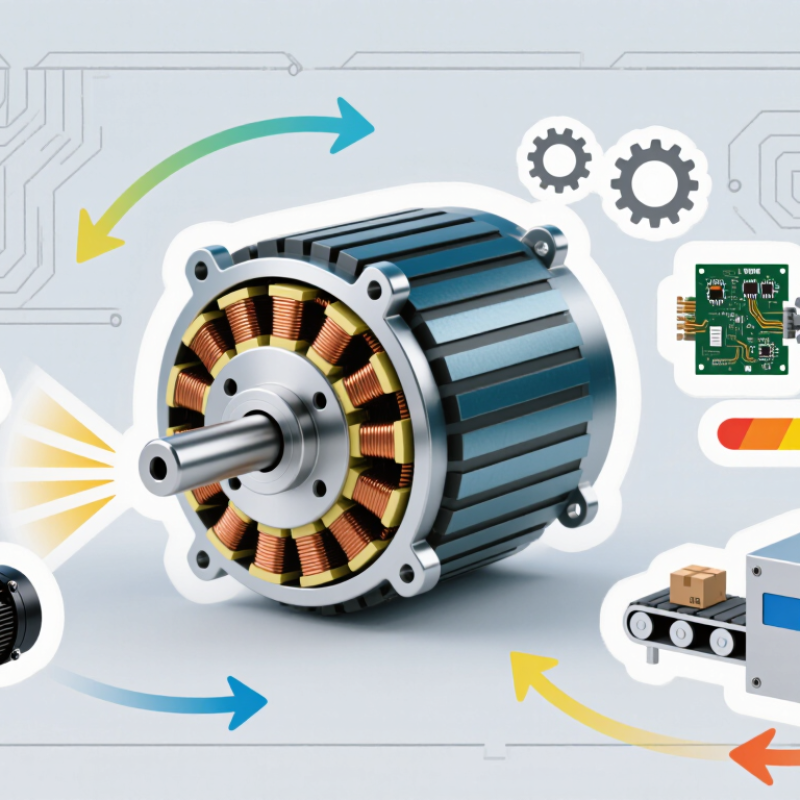
Why Choose a High Torque Brushless DC Motor?

What Defines a High-Torque Brushless DC Motor?

A high-torque brushless DC motor has no universal torque threshold. Its defining feature is the torque it can deliver for its size, speed, and operating conditions. Torque, measured in newton-metres, describes rotational force. For a loaded conveyor, startup torque matters: the motor must move the belt and its contents without stalling. A motor’s torque-speed curve shows how output changes as speed rises. Continuous torque is usually more useful than a brief peak rating.

There is a catch. Peak torque may last only seconds before heat becomes a concern. Compare continuous torque, current, and thermal limits at the intended speed.

The U.S. Department of Energy’s 2014 United States Industrial Electric Motor Systems Market Opportunities Assessment estimated that motor-driven systems used about 68% of electricity consumed by U.S. manufacturing. That figure covers many motor types, not BLDC motors alone, but it shows why efficiency deserves attention alongside torque.

Check the controller and cooling conditions behind a rating. Datasheets can leave those details unclear. Ask for test conditions, and compare motors at the same voltage and temperature.

How Its Design Generates High Torque

A high-torque brushless DC motor starts with a close interaction between its rotor magnets and stator windings. When current flows through the windings, it creates a rotating magnetic field. The rotor follows that field, producing turning force at the shaft. No brushes are needed. The key is how effectively the motor’s magnetic parts work together.

Geometry matters. A larger rotor radius gives magnetic forces more leverage, while a longer active stack can increase the area producing torque. More magnetic poles may also help deliver strong force at lower speeds, though the result depends on winding design and operating conditions. The air gap must stay small and consistent. Even a slight unevenness can reduce magnetic performance or cause unwanted vibration. Details matter.

The windings shape both torque and heat. Carefully selected wire size and coil arrangement can support higher current, but current also raises temperature. A motor may deliver impressive peak torque briefly, then need to reduce output as it warms. That trade-off is easy to overlook. In real equipment, cooling, load, and duty cycle matter as much as a torque figure on a specification sheet. Brushless construction can improve efficiency and control, but it does not automatically make every motor high torque.

Why Choose a High Torque Brushless DC Motor? — How Its Design Generates High Torque

This illustrative chart applies the motor torque relation T ≈ Kt × I, using a torque constant of 0.10 N·m/A. Brushless DC motors produce more torque as current increases, while magnetic design and winding choices determine the torque constant. Actual performance depends on the motor and operating conditions; these values are not measured product specifications.

Performance Benefits of High-Torque Brushless Motors

Why Choose a High Torque Brushless DC Motor?

Performance Benefits of High-Torque Brushless Motors

A high-torque brushless DC motor can move a heavy load without relying on a large reduction gearbox. Electronic commutation controls the magnetic field, while the motor’s design delivers strong torque at low speeds. In a packaging machine, that can mean steadier movement as a conveyor starts with boxes already on it. Fewer mechanical parts may also reduce backlash and maintenance. Less gear noise.

Efficiency still depends on the complete drive system, not the motor alone. The U.S. Department of Energy’s 2014 sourcebook, Improving Motor and Drive System Performance, reports that motor-driven systems account for about 68% of electricity use in U.S. manufacturing. That figure makes careful motor selection worthwhile, but it does not mean every brushless motor saves energy. An oversized motor or poorly tuned controller can waste power. That detail is easy to overlook.

Tips: Compare the motor’s torque-speed curve with the real load, including startup peaks. Check cooling, controller limits, and duty cycle before choosing. A little caution helps; the highest torque rating is not always the best fit.

Why Choose a High Torque Brushless DC Motor? — Performance Benefits of High-Torque Brushless Motors

The figures below are indicative engineering ranges, not guaranteed specifications. Actual performance depends on motor design, controller, operating speed, cooling, and load.

Performance Dimension High-Torque BLDC Motor Characteristic Practical Benefit Selection Consideration
Torque production Motor torque is approximately proportional to phase current: T = Kt × I, within the motor’s operating limits. Provides strong, controllable torque for starting, acceleration, and demanding loads. Check continuous and peak torque ratings, as well as the permitted duration of peak operation.
Low-speed operation Electronic commutation can maintain controlled torque at low speeds when paired with a suitable controller and feedback method. Useful in conveyors, positioning systems, robotics, and other applications that require controlled starts or slow movement. Confirm low-speed torque and speed stability under the actual load; these are not determined by the “high-torque” label alone.
Efficiency and heat Well-designed BLDC systems commonly achieve roughly 85–95% motor efficiency near suitable operating points; efficiency varies with load and speed. Less energy may be lost as heat, potentially reducing cooling requirements and operating costs. Compare efficiency maps at the expected duty point, and include controller and power-supply losses in system estimates.
Brush maintenance Electronic commutation eliminates mechanical brushes and their routine wear. Can reduce scheduled maintenance and avoid brush-related wear particles or commutation issues. Bearings, seals, connectors, and the controller still require appropriate inspection and maintenance.
Speed and torque control A compatible drive can regulate speed and torque by controlling phase current and commutation. Supports repeatable acceleration, adjustable speed, and integration with automated control systems. The motor and controller must be matched for voltage, current, feedback, and control requirements.
Continuous-duty capability Continuous torque is limited by winding temperature, cooling, ambient conditions, and the motor’s thermal design. A correctly sized motor can sustain demanding operation more reliably than one selected only by peak torque. Use the continuous torque rating for steady loads and check the application’s duty cycle and cooling method.
System size and load handling High torque can be achieved through motor geometry, winding design, current, and—in some systems—gearing. May help meet starting or load requirements in compact drive systems. Compare torque at the required shaft speed, including gearbox ratio, efficiency, backlash, and mounting constraints.
Noise and vibration No brush contact removes one source of mechanical noise, although electrical commutation and structural resonance can still produce sound or vibration. Can support quieter operation when the motor, drive settings, and mounting are properly selected. Check acoustic and vibration performance across the full speed range in the intended installation.

Applications That Require High Torque

Why Choose a High Torque Brushless DC Motor?

Applications That Require High Torque

High-torque brushless DC motors are useful when equipment must move heavy loads or start against resistance. Think of a conveyor belt starting with boxes already in place. Strong starting torque helps it move smoothly instead of jerking or stalling. These motors can also provide controlled motion at lower speeds, which matters when positioning a load precisely.

In robotics, joints may need to lift an arm while maintaining steady movement. In automated tools, a motor may drive a mechanism through repeated cycles without losing control. Compact lifting equipment and packaging machinery can also benefit from high torque in a limited space. The right choice depends on the actual load, speed, and operating pattern—not torque alone. That detail is easy to overlook.

A motor that looks adequate on paper can still struggle if it runs near its limit for long periods. Check continuous torque, peak torque, heat buildup, and how often the motor starts and stops. A gearbox may help, but it adds size and changes output speed. Test the motor with a realistic load when possible. A brief trial can reveal vibration or heating that calculations miss. Even careful sizing has limits.

Key Factors in Choosing a High-Torque Motor

Why Choose a High Torque Brushless DC Motor?

Key Factors in Choosing a High-Torque Motor

Choosing a high-torque brushless DC motor starts with the load, not the headline torque rating. Check the torque-speed curve at your actual supply voltage and operating speed. A motor may deliver strong peak torque briefly but overheat if asked to sustain it. Heat changes everything. Also compare continuous torque, duty cycle, and starting frequency. The U.S. Department of Energy’s 2014 Improving Motor and Drive System Performance sourcebook reports that motor-driven systems account for about 54% of electricity use in U.S. manufacturing. That figure highlights why matching a motor to its real workload matters.

Next, check whether the motor can accelerate the combined load. A conveyor carrying heavy boxes, for example, may need more starting torque than steady running torque. Include the inertia of belts, gears, and attached parts. Confirm that the controller, power supply, and cooling arrangement can support the required current. If using a gearbox, account for its efficiency and backlash. Check the curve. A first sizing estimate is useful, but real loads can surprise you; verify the choice with operating conditions or a measured prototype.

Tips: Record load, speed, starts per hour, and ambient temperature before comparing motors. Leave thermal margin, and ask for continuous—not only peak—torque data.

Site Feedback
Close