What Are the Different Types of Angle Steel?
Angle Steel is a practical L-shaped product used in frames, supports, braces, and many other structures. Its two legs meet at a right angle, but their dimensions and manufacturing methods can differ. Those differences affect how the steel fits, carries loads, and connects to nearby parts. A small mismatch can matter when a bracket must sit flush against a beam.
The main shape categories are equal-leg and unequal-leg angle steel. Equal-leg sections have legs of the same width, while unequal-leg sections combine a longer leg with a shorter one. Both are available in a range of thicknesses and lengths. Manufacturing offers another useful distinction: hot-rolled and cold-formed angles may differ in surface finish, dimensions, and suitability for particular work. Details vary by supplier and applicable product specifications.
There is no single best type. A workshop frame may need a different section from a building connection or equipment support. Buyers and designers typically check leg dimensions, thickness, steel grade, tolerances, and loading requirements before choosing. The exact specification matters. Product names alone can be misleading, and this is worth remembering. This guide outlines the common types of Angle Steel, explains how they differ, and describes practical points to consider when comparing them. It is a starting point, not a substitute for project-specific engineering review.
## Angle Steel Basics: L-Shaped Sections and Leg Dimensions
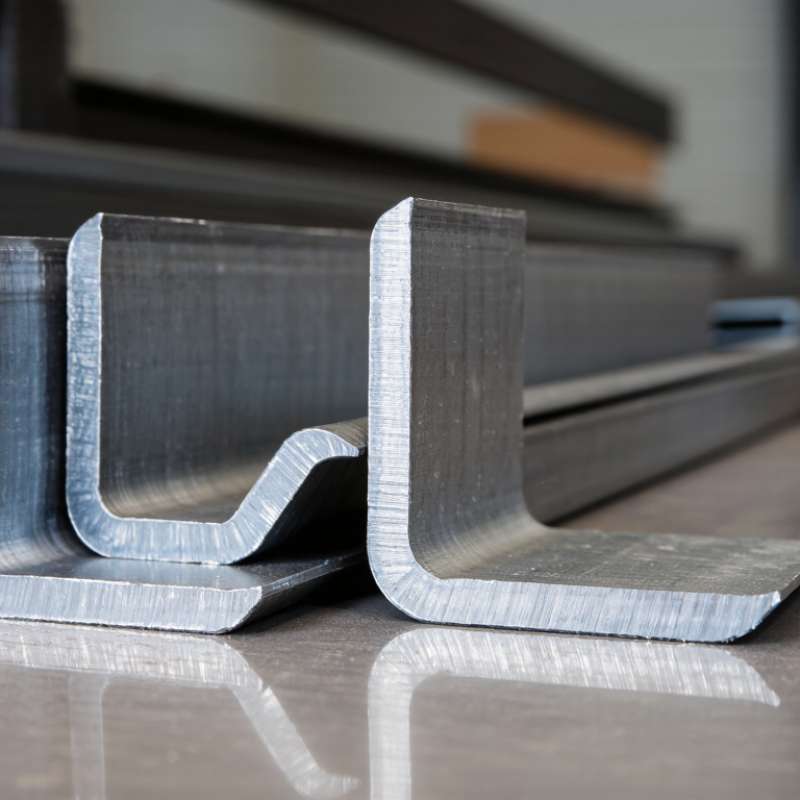
Angle steel is a structural section formed by two flat legs meeting at a right angle. Its cross-section looks like the letter L. The legs may be equal or unequal in width, depending on the section’s intended use. A 50 × 50 mm angle has two equal legs; a 75 × 50 mm angle has one longer leg. Simple, but easy to misread on a drawing.
Leg dimensions are measured from the heel, where the legs meet, toward each outer edge. The thickness is listed separately, such as 50 × 50 × 6 mm. These measurements describe the nominal section, not always the exact clear space inside the angle. The inner corner often has a radius, and that small curve can matter when the steel must sit tightly against another part. Check the supplier’s section table or measured sample before designing a close-fitting connection.
Equal-leg angles can provide balanced support on both sides of a joint. Unequal-leg angles are useful when one face needs more reach or bearing area. In practice, orientation matters: turning an unequal angle can change how loads pass into the connected parts. I have seen dimension notes copied without their order, leaving a 75 × 50 section uncertain. Write the longer leg first, and confirm the convention on the drawing. A small habit. It prevents avoidable fitting trouble.
## Equal-Leg and Unequal-Leg Angles: How Their Profiles Differ
Equal-leg and unequal-leg angles share an L-shaped profile, but their leg proportions change how they fit and carry loads. In an equal-leg angle, both legs have the same nominal length, giving a balanced-looking profile for corner bracing and frame connections. AISC’s Shapes Database, Version 16.0, lists an L4×4×½ at about 12.8 pounds per foot. That familiar size offers matching faces for attachment. That matters.
An unequal-leg angle has one longer leg, such as an L6×4×⅜. AISC’s database lists this section at about 12.2 pounds per foot. The longer face can provide more room for bolts or a wider bearing surface, while the shorter face may help the section fit into a tight corner. But the profile is not automatically stronger in every direction. Load direction, connection layout, thickness, and unsupported length all affect performance. AISC section properties also show why checking the angle’s centroid and bending axes matters: the legs do not distribute material symmetrically. A neat drawing can still mislead. Confirm the actual dimensions and orientation against the project’s section tables before specifying or fabricating the angle.
## Hot-Rolled and Cold-Formed Angle Steel: Key Production Types
What Are the Different Types of Angle Steel?
Hot-Rolled and Cold-Formed Angle Steel: Key Production Types
Hot-rolled angle steel is shaped while steel is heated, then cooled into equal-leg or unequal-leg sections. Its corners are usually rounded, and the surface may show mill scale. These angles often suit heavier frames, brackets, and exposed structural connections. ASTM A6/A6M sets general requirements for hot-rolled structural shapes, including dimensional tolerances. Check the actual section dimensions before specifying a fit.
Cold-formed angles are bent from sheet or strip at room temperature, often by press braking or roll forming. They typically have thinner, more consistent walls and sharper corners. A close look reveals the bend lines. Cold working can increase strength, but thin legs may buckle locally; the AISI S100 specification addresses design of cold-formed steel members. Neither production method is automatically better.
The World Steel Association’s World Steel in Figures 2024 reports 1,892.2 million tonnes of crude steel production worldwide in 2023. That figure covers all crude steel, not angle steel, so it cannot show which angle type is more common.
A practical choice depends on load, thickness, finish, and fabrication needs. One detail is easy to miss: coating and corner geometry can affect assembly, even when nominal leg sizes match. Check both.
## Structural Grades Compared: ASTM A36 at 36 ksi and A572 Grade 50 at 50 ksi
Angle steel is commonly supplied with equal or unequal legs, in a range of thicknesses and lengths. The shape is simple, but its grade affects how it performs under load. ASTM A36 has a specified minimum yield strength of 36 ksi, while ASTM A572 Grade 50 reaches 50 ksi.
That difference can matter in a frame or connection. A572 Grade 50 may allow a designer to use less steel for some strength-controlled applications. But higher yield strength does not automatically mean a lighter or better angle. Slender legs can still buckle, and bolt or weld details may govern the design. The whole connection matters.
A36 is often considered for general structural work where its strength and forming characteristics fit the job. A572 Grade 50 can suit applications needing greater specified strength, subject to the design requirements and material availability. Check the applicable specification and mill test report, then verify dimensions, chemistry, and welding requirements with a qualified professional. Small details count. I would not choose by grade alone; real load paths can be less tidy than a drawing suggests.
## Choosing Angle Steel by Load, Dimensions, and Application
Equal-leg angles suit frames and brackets needing similar support in both directions; unequal-leg angles fit details where one leg must span farther. Compare leg length, thickness, and section properties, not just the “L” designation. AISC Shapes Database v16.0 provides tabulated dimensions and geometric properties for standard shapes. Check the listed area and moment of inertia against the actual design load.
Material strength matters, but it does not replace sizing. ASTM A36 specifies a minimum yield strength of 36 ksi, while ASTM A572 Grade 50 specifies 50 ksi, subject to the applicable product requirements. For a long shelf bracket, a thicker angle may reduce bending, yet connection bolts and unsupported length can still govern. Small details count.
Match the section to how it will be loaded: axial force, bending, or both. Unequal-leg angles can introduce eccentric loading when connected through only one leg, so consider torsion and connection design. AISC’s Steel Construction Manual section-property tables help compare candidate sizes, but a table cannot capture every site condition. That part needs judgment. I would not choose solely by load rating; real installations often differ from the neat sketch. Check corrosion exposure, fit-up clearance, and whether the supporting material can carry the reaction.