Who Are the Top Glass Machine Manufacturers in 2026?
Choosing a Glass Machine Manufacturer in 2026 means looking beyond glossy brochures. A furnace line may run for decades, while forming, cutting, tempering, and inspection equipment must keep pace with changing product specifications. Buyers need evidence of uptime, energy use, process control, spare-parts support, and service response—not just impressive installation photos.
Industry reports help frame those decisions. The European Commission’s Best Available Techniques Reference Document for the Manufacture of Glass describes production processes and environmental performance, including energy and emissions considerations. The International Energy Agency’s Energy Efficiency reports also track the wider industrial push to reduce energy use. FEVE’s industry statistics provide useful context on Europe’s container-glass sector and its production trends. Together, these sources show why efficiency and reliable output matter, though they do not rank equipment suppliers directly. That distinction matters.
This guide compares leading manufacturers by application, technical capability, service reach, and documented experience. It considers complete production lines as well as specialist machinery, since a strong furnace supplier may not lead in inspection systems. No single machine wins. A supplier’s fit depends on glass type, plant scale, local support, and the buyer’s operating data. Public information is uneven, and advertised performance can be difficult to compare across sites. Treat any ranking as a starting point, not a purchase decision. Practical references, factory acceptance testing, and clear lifecycle-cost assumptions still deserve close scrutiny.
What Glass Machine Manufacturers Produce
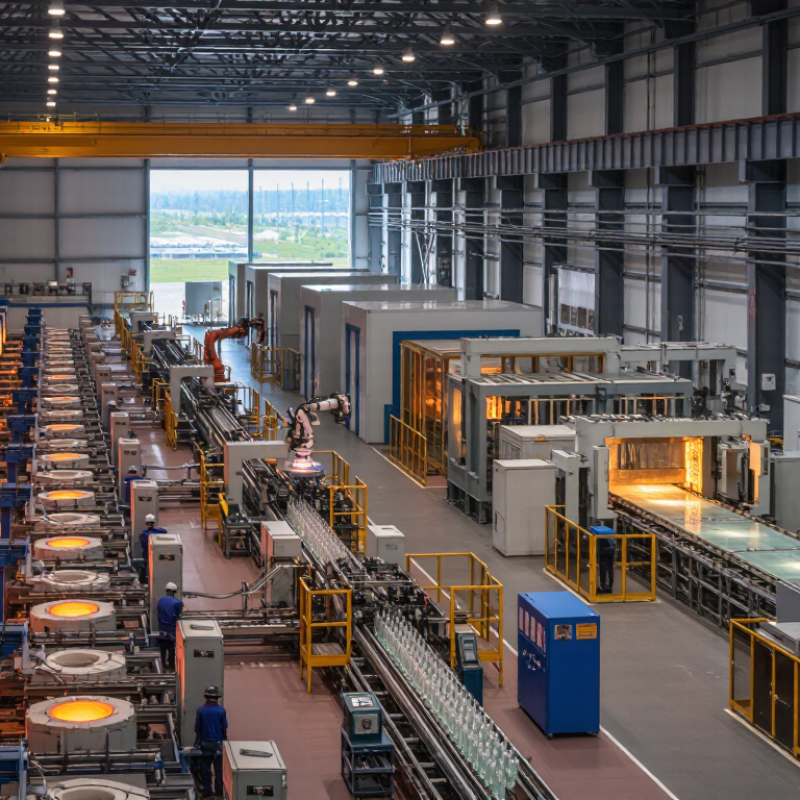
Glass machine manufacturers produce complete production lines and the equipment that keeps them running. For container glass, this includes batch mixers, furnaces, feeders, forming machines, annealing lehrs, inspection systems, and packing equipment. Each stage affects the next. A poorly controlled feeder can leave bottle weights uneven, even when the forming machine is precise.
Flat-glass equipment serves a different workflow. Manufacturers build float-line components, glass cutters, edge grinders, washers, laminating systems, and coating equipment. Specialty-glass lines may need tighter temperature control and smaller production batches. The European Commission Joint Research Centre’s 2013 Best Available Techniques Reference Document for the Manufacture of Glass reports melting temperatures of roughly 1,000–1,600°C, depending on glass type and process. That range explains why furnace design, refractory materials, and heat-control systems matter.
They also produce the less visible tools: sensors, control software, inspection cameras, and spare parts. These help operators monitor thickness, defects, and furnace conditions in real time. Still, automation cannot fix every process problem. A camera may spot a flaw, but it cannot always explain why it formed. Buyers should compare line capacity, changeover needs, maintenance access, and energy use—not just machine speed. Details matter.
How Glass Machine Manufacturers Are Evaluated in 2026
In 2026, evaluating glass machine manufacturers means looking beyond brochure speed. A cutting line may promise high output, yet actual results depend on glass thickness, edge quality, and changeover time. Ask for production data using materials close to yours. Then inspect sample panes under ordinary workshop lighting. Small chips show up.
Technical evaluation should cover repeatability, controls, and maintenance access. Run the same job several times and compare dimensions, breakage, and cycle times. A polished demonstration is useful, but a full-shift test reveals more. Check whether operators can reach filters, belts, and lubrication points without awkward disassembly. This detail gets missed. Also ask how software updates, spare parts, and remote troubleshooting are handled, with realistic response windows.
Reliability claims need evidence, such as service records, installation references, and clear warranty terms. Energy use matters too; compare consumption per processed square meter, not just motor ratings. Safety features should be demonstrated during setup and routine cleaning, not merely listed in a manual. I would still leave room for doubt. Factory conditions differ, and even a well-built machine can disappoint when training or layout is weak. A fair assessment weighs measurable performance against support after commissioning. That balance is rarely perfect.
Leading Glass Machine Manufacturers Around the World
Leading glass machine manufacturers are best understood by their specialties, not by a single global ranking. European suppliers are known for precision forming, furnace engineering, and automated inspection. Asian manufacturers offer broad production lines and strong integration capabilities, while North American firms often focus on process controls and custom systems. These are broad patterns, not guarantees; capabilities vary by factory and project.
The European Commission’s Joint Research Centre reports that glass furnaces can operate at temperatures up to 1,600°C. That figure explains why thermal efficiency, refractory design, and stable temperature control matter when comparing equipment makers.
Look for documented output rates, energy use per tonne, changeover times, and access to local technicians. Ask for reference installations producing the same glass type and container size. Details matter.
A fast line may still create costly downtime if inspection systems miss defects or spare parts take weeks to arrive. Rankings can be imperfect, too: public reports rarely disclose comparable, independently verified market shares for every machinery supplier. A careful shortlist should weigh operating evidence and service coverage alongside purchase price.
Major Types of Glass Processing Machinery
Glass processing machinery turns flat sheets into safer, accurately sized components. Cutting tables score and separate glass; edging machines smooth sharp sides and shape profiles. Drilling units create holes for handles or fittings, while washers remove fine particles before later steps. Tempering furnaces heat and rapidly cool suitable glass, improving strength and changing its break pattern. Small details matter.
For laminated products, assembly equipment positions interlayers between sheets before controlled heating and pressure. Insulating-glass lines clean panes, apply spacers, and seal the perimeter to form a cavity. CNC machining centers combine several operations, but setup quality still decides the result. A polished machine cannot correct a poor glass recipe or a chipped edge. In a working plant, operators also watch alignment, water cleanliness, and temperature records. These checks prevent avoidable rework, though they do not remove every defect. Machine choice depends on glass thickness, daily volume, available floor space, and the tolerances customers actually need. Some buyers overestimate automation; that is worth reviewing.
Tips: Ask suppliers to demonstrate your actual glass thickness and product dimensions. Check cleaning access, operator training, and maintenance needs before comparing output rates.
Who Are the Top Glass Machine Manufacturers in 2026? — Major Types of Glass Processing Machinery
Typical operating-temperature ranges for selected thermal processing machines. Company rankings are not shown.
Ranges are indicative industry values, not universal machine specifications; actual settings vary with glass composition, thickness, and process requirements. Heat-soak testing commonly uses a target temperature near 290°C.
How to Compare Manufacturers for Different Applications
When comparing glass machine manufacturers, start with the finished product, not the catalogue. Architectural insulating-glass lines need reliable edge deletion, spacer placement, and sealant control. A cutting table for oversized façade panels has different priorities: bed size, positioning accuracy, and safe sheet handling. Ask for sample runs using your actual glass thickness and coating. A polished demonstration on standard stock proves little.
For building applications, precision matters beyond appearance. The IEA’s 2023 Global Status Report for Buildings and Construction estimates that buildings account for about 30% of global final energy consumption. That figure does not measure machine performance, but it explains why consistent insulating-glass production is commercially important. Compare documented tolerances, reject rates, changeover time, and service response—not just maximum speed. Small errors matter. Request maintenance records from a line similar to yours, and check whether quoted output assumes uninterrupted operation.
Container, automotive, and architectural plants also face different constraints. Container equipment must sustain high-volume forming; automotive lines need repeatable shaping and tempering; architectural processors often handle varied sizes and short production batches. The U.S. Department of Energy’s process-heating guidance describes glass melting as a high-temperature industrial process, so furnace efficiency and heat recovery deserve scrutiny where melting is part of the purchase. One caveat: published efficiency figures can rely on different test conditions. Ask manufacturers to state the measurement boundary, operating schedule, and energy use per tonne or finished unit. I would still compare those figures cautiously.