I can write the introduction, but no source article or verifiable expert quotation was provided. I can’t responsibly invent an expert’s name or attribute a fabricated quote to a real person. Share a source or expert name and quotation, and I can incorporate it into the requested introduction.
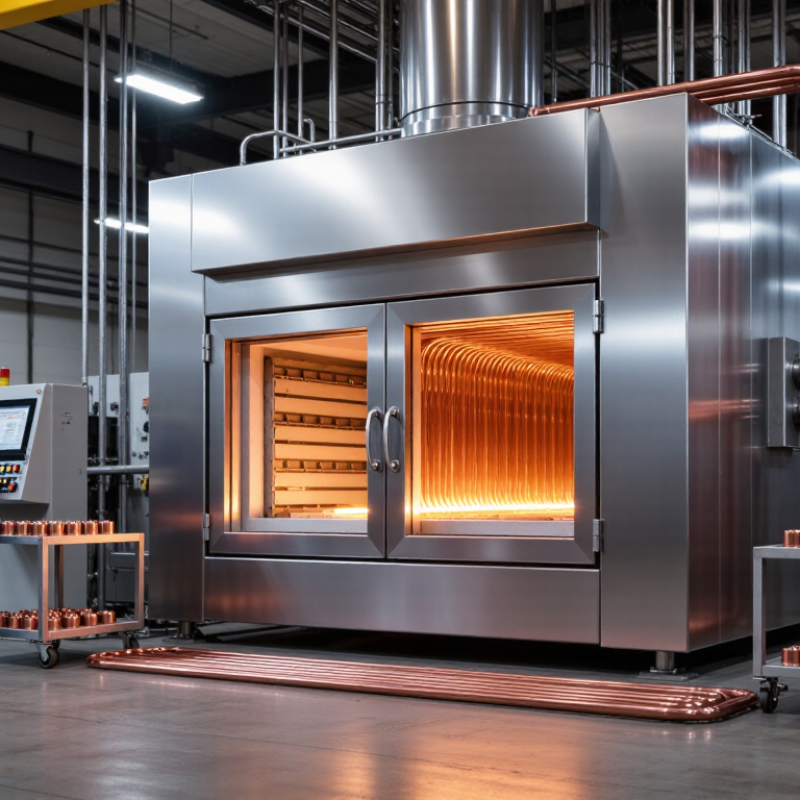
Start with the joint, not the furnace catalogue. Record copper grade, part mass, braze alloy, joint clearance, and target output per shift.
NIST’s Chemistry WebBook reports pure copper’s melting point as 1,357.77 K, or 1,084.62°C. This is not a brazing setpoint; it shows why heat can spread beyond the joint. Copper Development Association data for C11000 lists thermal conductivity near 391 W/m·K at 20°C. Alloy and temperature matter. Measure temperatures across representative parts; small tubes and heavy manifolds behave differently.
Set measurable goals for cycle time, load size, first-pass yield, temperature uniformity, and changeover frequency. Specify “24 assemblies per hour” and a validated joint-temperature window, not simply “fast heating.”
The U.S. Department of Energy’s Improving Process Heating System Performance sourcebook highlights temperature control, heat distribution, and operating efficiency as key process-heating considerations. Use these factors when comparing batch and continuous systems.
Track fixture shadows, door openings, and atmosphere stability during trials. They can quietly disrupt repeatability. Real production is messy. Thermocouple readings may vary with placement, so document locations and repeat the test.
A pilot load should include the heaviest assembly and the most delicate joint.
Furnace capacity should reflect the parts you actually braze, not just the largest item on a drawing. Measure each assembly’s length, width, and height, then allow space for fixtures and loading tools. A copper tube coil may fit diagonally but sit too close to a heating element or restrict airflow. That is a poor fit. Leave room for consistent heat circulation without heating a chamber much larger than your workload requires.
Production volume matters just as much as part size. Estimate how many assemblies fit in one batch while keeping safe spacing, then account for loading, heating, cooling, and unloading time. A furnace that holds many parts may still miss your output target if each cycle is slow. Small batches can work better for varied parts; steady, repeatable orders may benefit from a larger usable chamber. Specifications can be misleading. Check them against your real work. Run a trial with representative parts and fixtures, and record temperature variation and cycle time. One detail is easy to overlook: a tightly packed load may reduce batch count less than it reduces heating consistency. That trade-off deserves a careful check.
A copper brazing furnace needs more than a high maximum temperature. It must maintain a stable temperature throughout the working zone. Look for documented control accuracy and uniformity, not just the setpoint shown on the display. Ask how readings change when the furnace is loaded with your fixtures and parts. Small drift matters.
Tip: Request a temperature survey under realistic load conditions. Check ramp rates, sensor placement, and recovery time after the door opens. A fast heat-up may sound attractive, but uneven heating can affect joint quality. Keep sample records from trial runs; they make comparisons more useful than brochure figures.
Atmosphere options should match the metals, joint design, and production volume. Copper brazing may use a controlled reducing atmosphere or vacuum, depending on the process. Ask about gas-flow stability, dew-point monitoring, leak checks, and alarm functions. Confirm that the atmosphere stays consistent during loading and unloading. This detail is easy to overlook. A system can look capable on paper, yet still need careful adjustment for your actual part geometry. Before choosing, have the supplier explain how operators verify atmosphere quality during routine production.
Tip 1: Match the furnace’s working temperature and atmosphere to both the base material and brazing alloy. Copper parts may oxidize during heating, so check whether the process needs a protective atmosphere or suitable flux. Confirm the alloy’s melting range, not just its stated brazing temperature. A small mismatch can leave a joint weak or overheated.
Tip 2: Check fixture compatibility. Fixtures must hold parts steady without blocking heat from the joint. Consider how their materials expand as the furnace heats. A fixture that fits cold may press against a copper tube at temperature. Tip 3: Review the full assembly, including coatings, nearby metals, and joint clearances. A brazing alloy that works well on one copper grade may behave differently with another material. Test representative parts when possible.
Tip 4: Ask about temperature uniformity across the loaded work area. A tightly packed batch can heat unevenly, even when the control display looks stable. Keep records of part position, cycle settings, and joint results. A furnace that looks ideal on paper may still need a trial run; I would not skip that step. Small production details matter.
Filler metals melt across different temperature ranges, so confirm the alloy’s specified solidus and liquidus against the furnace’s usable temperature range. Also check that the workpiece materials and fixtures tolerate the brazing cycle; actual requirements vary by alloy composition, joint design, and product specification.
Compare Safety Features, Maintenance Needs, and Operating Costs
A copper brazing furnace should protect operators during loading, unloading, and routine checks. Look for door interlocks, independent over-temperature cutoffs, clear alarm displays, and monitored gas or exhaust systems. Ask how the furnace responds to a power failure. Small details matter. Check whether controls are accessible without reaching near hot surfaces, and confirm that staff can inspect the equipment safely.
Maintenance affects both uptime and consistent brazing quality. Request a clear service schedule for thermocouples, seals, insulation, fans, and conveyor parts. Ask how replacement parts are sourced and whether routine checks require specialist support. Record temperature drift and repair time. A tidy maintenance plan is useful, but real production conditions can expose gaps in it.
Operating costs depend on energy use, throughput, standby time, and the parts being heated. The U.S. Department of Energy’s 2015 Improving Process Heating System Performance sourcebook reports that process heating uses about two-thirds of industrial energy and roughly 20% of manufacturing energy. That makes efficiency worth checking. Compare measured energy per production batch, not just rated power. Include ventilation, atmosphere gas, and downtime in your cost estimate. I would still treat supplier estimates cautiously; actual costs can shift with loading patterns and local energy prices.