Skip to content
Menu Close

China Best Machinery Gasket Manufacturers and Suppliers

China’s Machinery Gasket manufacturing sector serves equipment builders, maintenance teams, and distributors across many industries. A Machinery Gasket may look like a simple ring or cut sheet, yet its performance depends on material, thickness, surface finish, and operating conditions. Heat, pressure, vibration, and exposure to oil or coolant can all affect sealing reliability.

This guide introduces China’s leading machinery gasket manufacturers and suppliers, with attention to product range, production capability, quality controls, and technical support. Buyers can compare options such as rubber, cork, graphite, and metal-reinforced designs, then request drawings, material data, dimensional tolerances, and sample pieces. Small details matter. A gasket that fits a test fixture may still behave differently in a running machine, so application-specific validation is worth discussing with the supplier.

Reliable sourcing is not only about price or a polished catalog. Review how a manufacturer handles incoming materials, inspection records, traceability, and corrective actions when a part misses specification. Ask about minimum order quantities, lead times, packaging, and communication during design changes. These points can reveal how practical a supplier will be after the first order.

No supplier is ideal for every application. Requirements differ, and available evidence may not answer every question. Use the profiles and comparison criteria ahead as a starting point, then verify technical claims against your equipment’s real operating conditions. A careful conversation can prevent an expensive leak.
China Best Machinery Gasket Manufacturers and Suppliers

What Machinery Gaskets Are and How They Work

A machinery gasket is a compressible sealing element placed between two joined surfaces. It helps prevent liquids, gases, dust, or pressure from escaping through small gaps. In pumps, gearboxes, and compressors, these gaps may occur around covers, flanges, or inspection ports. As bolts apply controlled compression, the gasket fills uneven spots and creates contact across the joint. That pressure slows leakage. Simple, but not foolproof.

The gasket material must suit the fluid, temperature, pressure, and vibration. Otherwise, it may soften, crack, or gradually lose compression. Before fitting a replacement, a technician checks for scratches, corrosion, and old residue on the mating surfaces. Even a tiny burr matters. Uneven bolt force can crush one area while leaving another loose. Follow equipment specifications; tighter is not always safer. Rushed repairs can miss small defects.

Tips: Clean both faces, align the gasket without stretching it, and tighten bolts in the specified sequence and stages. After startup, inspect from a safe position for seepage. A dry joint is useful evidence, not a guarantee.

Common Types of Machinery Gaskets Made in China

Common Types of Machinery Gaskets Made in China

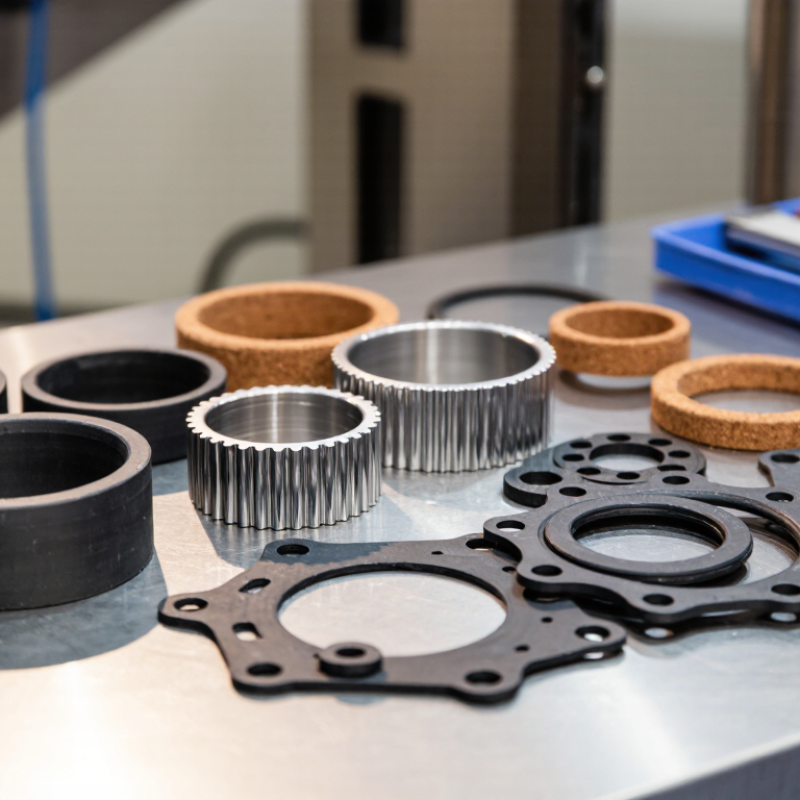
Machinery gasket suppliers in China commonly offer compressed fiber sheets, graphite, PTFE, rubber, and metal-wound designs. Each type suits different operating conditions. Compressed sheets are often used for pump covers and pipe connections with moderate heat and pressure. Graphite handles higher temperatures, but oxidation and handling can affect performance. PTFE resists many chemicals, though it can creep under sustained pressure. Rubber gaskets provide flexibility for low-pressure water or air connections. For hotter, higher-pressure service, spiral-wound metal gaskets may be considered. Small details matter.

Tips: Match gasket material to the actual fluid, temperature, pressure, and flange surface. Check dimensions, thickness, and bolt loading against equipment specifications. Ask for material and inspection documentation when comparing suppliers. A gasket that fits the flange may still leak if the surface is damaged or the compression is uneven.

Selection is rarely as simple as choosing the toughest material. A hard gasket can be unsuitable for a rough flange, while a softer one may deform during operation. Review the equipment’s service history, and note changes in vibration or temperature. These clues can help narrow the options, but they do not replace engineering checks. Leave room for doubt: operating conditions can vary from the original design assumptions.

How Machinery Gaskets Are Manufactured and Tested

China Best Machinery Gasket Manufacturers and Suppliers

How Machinery Gaskets Are Manufactured and Tested

Machinery gaskets begin with a service requirement: temperature, pressure, fluid, and flange shape. Technicians select sheet material, then cut it by die, CNC knife, or waterjet. A sharp edge matters. Burrs and uneven thickness can create leak paths. For molded or metal-reinforced designs, forming and bonding steps need close process control. Each batch should be checked for dimensions, visible defects, and material traceability.

Testing turns a drawing into measurable evidence. ASTM F36/F36M measures gasket compressibility and recovery as percentages. ASTM F37 evaluates sealability through controlled leakage tests. ASME PCC-1 provides guidance for assembling bolted flange joints, where bolt load and tightening sequence affect sealing. Test pressure and acceptance limits should match the gasket’s intended service, not a convenient factory setting. One pass is not proof of long-term reliability; real operating cycles can expose weaknesses.

Tips: Ask for the material lot, thickness readings, and test conditions—not just a “passed” label. Compare leakage results under the same pressure and loading. Keep a sample from each production batch. Small details matter, and specifications sometimes need revision after field feedback.

Key Factors for Choosing a Chinese Gasket Manufacturer

Choosing a Chinese gasket manufacturer requires more than comparing unit prices. MarketsandMarkets’ Industrial Gaskets Market report estimated the market at USD 11.6 billion in 2023, with growth driven by demand across industrial sectors. That scale makes supplier capability worth checking carefully. Ask for material certificates, dimensional inspection records, and test results for the exact gasket grade you plan to buy. A polished sample is not enough. Request production samples from a normal batch, then compare thickness, cut edges, and hole alignment against your drawings.

Check whether the factory can explain how it controls incoming materials, tooling, and batch traceability. For high-temperature or pressure service, confirm the specified material and test method with your engineering team; a generic “high-performance” claim proves little. Review the supplier’s quality-system certificate and verify its scope and validity. Video audits can help, but they cannot replace independent inspection when the risk is high. Small details matter. A slightly uneven flange surface can undermine an otherwise sound gasket. Ask how defects are recorded and corrected, not only how many products pass inspection. No audit is perfect, and I would treat missing batch records as a warning, even when the quoted price looks attractive.

Typical Temperature Ranges for Common Gasket Materials

Temperature capability is one factor when evaluating a machinery gasket supplier. These indicative ranges vary by grade, formulation, operating medium, pressure, and exposure conditions. Confirm the limits against the specific product’s technical datasheet and your application requirements.

How to Compare Chinese Gasket Suppliers for Your Needs

China Best Machinery Gasket Manufacturers and Suppliers

How to Compare Chinese Gasket Suppliers for Your Needs

Comparing Chinese gasket suppliers starts with the conditions your part must handle. Share the drawing, operating temperature, pressure, fluid, and expected service life. A gasket for a warm water pump may need different material properties from one exposed to oil or repeated compression. Check whether the supplier can explain material selection and confirm dimensions, thickness, and tolerances in writing. Small details matter. Ask for sample inspection records and material batch traceability, where relevant. A low quotation means little if the part arrives with uneven thickness or does not seal reliably.

Tips: Send the same specification to each supplier. Ask about sample lead time, production capacity, inspection methods, packaging, and replacement procedures. Request relevant test reports, and verify that their scope matches your application. Compare landed cost and delivery estimates, not just the unit price.

It is easy to overvalue price; I would not use it as the only measure. Review a sample against your drawing, including edge quality and fit, and ask how changes are controlled after approval. Clear answers are useful, but written evidence is better. One awkward point: a supplier may not have every document your team expects. Decide which records are essential before ordering, and keep a small buffer for testing and production adjustments.

China Best Machinery Gasket Manufacturers and Suppliers - How to Compare Chinese Gasket Suppliers for Your Needs

Evaluation Dimension What to Compare Evidence to Request Why It Matters
Product and material range Check whether the supplier makes the gasket type and material your application requires, such as non-metallic sheet gaskets, rubber gaskets, PTFE gaskets, spiral-wound gaskets, or ring-type joint gaskets. Product catalogue, material specifications, available dimensions, and confirmation of whether products are made in-house or sourced externally. Different gasket constructions suit different flange designs, media, temperatures, pressures, and operating conditions.
Application and material suitability Compare the supplier’s ability to recommend materials for the actual fluid or gas, operating temperature, pressure, flange surface, and expected service conditions. Written material recommendation with stated assumptions; material safety or compliance documents where relevant; technical review of the application data. A gasket that is incompatible with the process medium or operating conditions can leak, degrade, or fail prematurely.
Manufacturing capability Review the processes relevant to the product, such as sheet cutting, die cutting, CNC cutting, rubber molding, winding, or metal-jacket fabrication. Process overview, production equipment list, sample parts, dimensional inspection records, and clarification of which processes are performed at the supplier’s facility. Process capability affects dimensional consistency, edge quality, repeatability, and the supplier’s ability to handle custom drawings.
Standards and technical references Confirm that the supplier can work to the standards and drawings applicable to the order. Relevant references may include ASME B16.20 for metallic gaskets, ASME B16.21 for nonmetallic flat gaskets, and EN 1514 for flange gaskets. Standard-specific product data, drawings, inspection reports, and written confirmation of the standard edition and product scope being quoted. Standards define requirements for particular gasket types and dimensions; citing a standard alone does not prove that a specific product conforms.
Testing and inspection Compare incoming-material checks, in-process controls, final dimensional inspection, and any application-relevant performance testing. Sample inspection report, batch traceability information, and test methods used. ASTM F36 is a commonly referenced method for measuring gasket compressibility and recovery; ASTM F37 addresses gasket sealability testing. Test methods and inspection records help establish whether the supplied batch meets agreed requirements. Test results should be tied to the product and batch being purchased.
Quality management and traceability Assess documented procedures for material identification, production control, nonconforming products, corrective action, and lot or batch traceability. Current quality-management certificate, certificate scope and issuing body details, sample material certificate, and example batch records. ISO 9001 concerns quality-management systems, not automatic certification of every product. Documented controls make it easier to investigate defects, verify materials, and maintain consistent supply.
Custom drawing and engineering support Check how the supplier reviews drawings, tolerances, flange details, material specifications, and revisions before production. Drawing review process, marked-up sample drawing, confirmation of revision control, and a first-article inspection plan for custom parts. Clear engineering review reduces errors caused by mismatched dimensions, unclear specifications, or outdated drawing revisions.
Order planning and delivery Compare quoted production lead time, sample timing, capacity for repeat orders, packaging, and the process for communicating delays. Written lead-time commitment for the specific order, production schedule, packaging specification, and shipping terms. Delivery performance depends on product complexity, material availability, order quantity, and shipping arrangements; request an order-specific estimate rather than relying on a general claim.
Commercial clarity Review quotation detail, minimum order quantity, tooling or setup charges, payment terms, warranty terms, and the treatment of specification changes. Itemized quotation, written terms and conditions, sample or tooling charges, and a clear process for approving substitutions or deviations. Transparent terms help compare offers on a like-for-like basis and reduce misunderstandings after an order is placed.
Communication and issue handling Assess response quality, technical understanding, document accuracy, and the process for handling complaints or corrective actions. Responses to a technical inquiry, sample nonconformance report, corrective-action example with confidential information removed, and named points of contact by role. Reliable communication is important when specifications change, delivery risks arise, or a product needs investigation.

Comparison tip: Send each shortlisted supplier the same drawing, material requirements, operating conditions, inspection criteria, quantity, and delivery destination. Compare their written responses and supporting documents rather than relying on general capability claims.

Site Feedback
Close