Choosing the 2026 Best Silicone Whisk Set for Wholesale Buyers takes more than comparing colors and unit prices. A set may look polished in a product photo, yet perform poorly when its handle feels slippery or its wires bend during everyday mixing. Small details matter. This guide focuses on the checks buyers can make before placing a larger order: whisk size, wire shape, handle comfort, packaging, sample quality, and supplier communication. A useful Silicone Whisk Set should suit real kitchen tasks, from whisking eggs in a small bowl to blending batter in a deeper mixing jug.
Material claims deserve a careful look. Ask suppliers for clear specifications, including temperature guidance, construction details, and relevant food-contact documentation for your intended market. Silicone does not make every design equally durable. A reinforced core, secure connection, and neatly finished edges can affect how a whisk feels after repeated use. Request samples when possible, then inspect them by hand. Are the wires evenly spaced? Does the handle stay comfortable when wet? Does the set arrive cleanly packed, with sizes easy to identify? These checks are simple, but they can reveal issues a catalogue misses.
Wholesale decisions also involve practical trade-offs. A low price may matter less if colors vary between batches or lead times remain unclear. Confirm minimum order quantities, packaging options, sample costs, and reorder consistency in writing. I would not assume that the largest set is automatically the best value; some buyers may prefer fewer, more useful sizes. That judgment can change by customer and market. This overview offers a grounded starting point, not a guarantee: compare specifications, test samples, and choose a supplier whose answers stay precise.
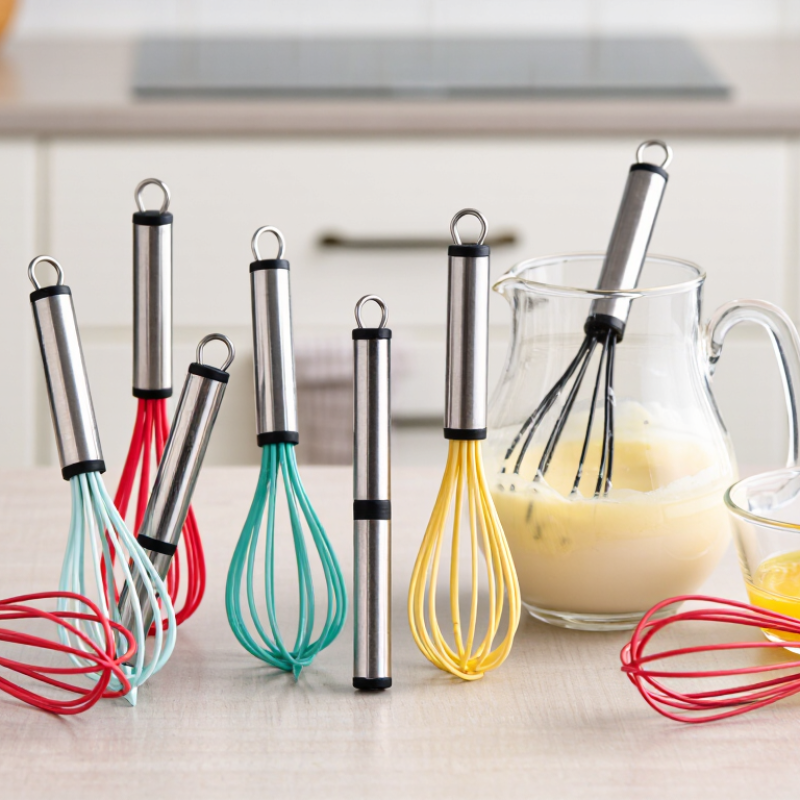
A silicone whisk set for wholesale buyers is defined less by its color than by consistent construction and useful performance. Check the wire thickness, spacing, and attachment to the handle. The wires should flex without feeling loose, and the handle should stay comfortable during repeated mixing. Small differences matter. A whisk that works well in one sample may feel different in another production batch, so inspect several units when possible. There is no perfect specification; the right balance depends on the intended use and target price.
Wholesale buyers should request product samples and clear details about materials, care, and recommended heat exposure. Compare how each whisk handles thick batter, light sauces, and a quick rinse by hand. Ask suppliers how they check batch consistency, and review their written product information rather than relying on verbal assurances. Packaging matters too. Nested sets can save shelf and shipping space, but cramped packaging may bend the wires. Some samples look excellent at first glance. Give them a closer look after repeated use, because comfort and durability are harder to judge in a single test.
For wholesale buyers, “silicone” alone says little about whisk performance. The wire core, coating thickness, and joint between head and handle matter just as much. A thin, uneven coating can expose metal after repeated bending, while a loose joint may trap water during washing. Small details matter.
The U.S. FDA’s 21 CFR 177.2600 sets extraction limits for certain repeated-use rubber articles: water extractives must not exceed 20 mg per square inch in the first seven hours, or 1 mg in the following two hours. These figures apply under specified test conditions; they do not certify every finished whisk. Ask suppliers for food-contact documentation and test records tied to the actual product. Useful checks include coating continuity, attachment strength, and repeated flex testing. ASTM D412 provides a method for measuring rubber tensile properties, though tensile data alone cannot predict whisk life.
Construction affects daily use. A stainless-steel core gives the handle structure, but full, consistent encapsulation helps prevent corrosion and coating separation. Broad, smoothly finished wires reach bowl edges more reliably; crowded wires can leave thick batter behind. Handles should feel firm, not slippery, with no sharp seams. Dishwasher testing matters, too. Results can vary with detergent and cycle temperature. That part is easy to overlook. Ask for samples and compare them after repeated washing and stirring. A neat first impression is useful, but not enough.
Use this comparison as a sourcing checklist, not as a claim that every product with a given material performs identically. Silicone formulations, dimensions, workmanship, and stated temperature limits vary by supplier; verify specifications and test samples before ordering.
| Evaluation Dimension | Common Material or Construction | Effect on Performance | Wholesale Buyer Checks |
|---|---|---|---|
| Whisk head | Food-contact silicone-coated stainless-steel wires; alternatively, all-silicone loops without a metal core. | A metal core generally helps the wires retain their shape and provide whisking tension. Unreinforced loops may be more flexible, while their stiffness and durability depend on design and silicone formulation. | Inspect wire symmetry, coating coverage, loop spacing, and shape recovery after repeated bending. Check that no metal is exposed at tips or joins. |
| Wire core | Stainless steel is commonly used as the internal support in coated-wire whisks. The steel grade should be specified by the supplier rather than assumed. | Core stiffness affects control and mixing response. Corrosion resistance depends on the steel grade, processing, and exposure conditions. | Request the declared steel grade and corrosion-related documentation where relevant. Inspect cut ends and attachment points for rust, burrs, or exposed core. |
| Silicone coating | Silicone elastomer formulated for food-contact applications, applied over the whisk wires. | The coating helps reduce direct metal contact with cookware, but thin, uneven, damaged, or poorly bonded coating can wear or separate in use. | Check coating continuity and thickness consistency visually; use repeated-use and cleaning tests to assess peeling, cracking, discoloration, and exposed wire. |
| Heat performance | Temperature limits are product- and formulation-specific; silicone kitchen tools may have different stated limits from one supplier to another. | Heat exposure can affect the silicone, handle, and joints differently. A generic silicone temperature claim does not establish the limit of the complete whisk. | Obtain the supplier’s stated maximum and minimum use temperatures for the finished product. Confirm test conditions and assess the handle and joint as well as the whisk head. |
| Handle material | Common options include silicone-covered handles, polypropylene handles, and stainless-steel handles. | Handle material influences grip, weight, heat transfer, cleaning, and perceived durability. Performance also depends on shape, surface finish, and how the handle is joined to the head. | Compare grip comfort with wet hands, balance, surface finish, and handle deformation after the supplier’s recommended heat and cleaning conditions. |
| Head-to-handle joint | Examples include a mechanically secured wire bundle, an overmolded connection, or a bonded connection. | The joint is a potential weak point. A secure, well-finished connection helps resist loosening and can reduce gaps where food or water may collect. | Check for movement, visible gaps, sharp edges, and residue traps. Conduct repeated stirring and washing cycles, then recheck the joint for looseness or separation. |
| Whisk sizes in a set | A set may combine different head lengths or shapes, such as balloon-style and compact whisks; exact dimensions should be stated for each piece. | Different sizes support different bowl sizes and tasks. A set with clearly differentiated sizes is easier to merchandise and use than pieces with minimal functional distinction. | Request head length, overall length, and wire-span measurements in millimetres or inches. Confirm that each size has a defined use and consistent dimensions across production lots. |
| Cookware contact | Flexible, silicone-coated wires are commonly selected for use with coated cookware, subject to the cookware maker’s care instructions. | Silicone coating can reduce direct metal contact, but it does not guarantee that a whisk will never mark cookware. Wear, exposed wire, pressure, and coating condition matter. | Test samples on representative cookware using normal mixing pressure. Inspect both the whisk coating and cookware surface after repeated use. |
| Cleaning and hygiene | Cleaning suitability depends on the finished product, including the handle and joint, not only the silicone material. | Smooth surfaces and accessible joints are easier to inspect and clean. Dishwasher suitability should be supported by product-specific instructions or testing. | Request care instructions and dishwasher-cycle evidence if dishwasher-safe claims are planned. Check for water retention, trapped food, and changes after repeated washing. |
| Food-contact documentation | Compliance requirements depend on the destination market and the product’s materials and intended conditions of use. | Material names alone do not establish regulatory compliance. Documentation should relate to the finished article and its intended food-contact conditions. | Identify target markets before purchase. Request applicable declarations, test reports, and traceability documents; confirm that they cover the supplied materials and product configuration. |
| Wholesale quality control | Sample inspection and production checks can cover dimensions, appearance, assembly, packaging, and functional performance. | Defined acceptance criteria help keep production lots consistent and make defects easier to identify before shipment. | Agree on measurable specifications, sampling plans, defect criteria, packaging requirements, and any required pre-shipment inspection before confirming an order. |
When comparing silicone whisk sets, look beyond the number of pieces. Check whether each whisk has a stainless-steel core, which helps it keep its shape during repeated mixing. The silicone should feel smooth and evenly bonded, without gaps near the handle. Inspect the stated heat range and request supporting product documents rather than relying on a sales description.
Ratings matter.
Handle design affects daily use. A broad, textured grip can feel steadier when mixing thick pancake batter, while a hanging loop may help with storage. Check that the handle does not trap water around seams. Ask whether the whisk heads are suitable for nonstick cookware, and confirm cleaning instructions.
Easy to clean.
For wholesale orders, compare sample quality, carton dimensions, available colors, and packaging options. Test a sample in a bowl: whisk a small portion of cream, then scrape the sides and inspect for loose strands or trapped residue.
One sample is not proof of consistent bulk production, though. Request a pre-production sample and clear inspection criteria before confirming quantities. Slight differences between batches can happen, so define acceptable finish and dimensions in writing.
For a 2026 wholesale silicone whisk set, quality starts at the join. Pull and twist the whisk head; look for gaps, loose wires, or silicone that splits around the core. Ask suppliers for heat-cycle, dishwasher, and food-contact test reports covering the finished whisk, not only its raw silicone. Test the colors and sizes you plan to order. Small details matter.
Safety claims need traceable evidence. In the United States, FDA regulation 21 CFR 177.2600 sets extractives limits for repeat-use rubber articles used with aqueous foods: 20 mg per square inch after the first extraction and 1 mg per square inch after the subsequent extraction. This is a useful benchmark, not proof that every silicone whisk complies. In Europe, check applicable food-contact requirements, including Regulations (EC) No 1935/2004 and 2023/2006. Request a current declaration of compliance, test methods, and batch-linked records. A certificate with no matching product details is weak evidence.
Tips: Compare test reports with the exact model, color, and intended use. Rub the whisk against a white cloth after washing; transferred color deserves a supplier query. Keep records. I would also inspect samples after repeated use—buyers sometimes skip this, and it can reveal defects paperwork misses.
How should buyers evaluate quality, safety, and compliance?
Suggested buyer-defined evaluation weights, not survey results: prioritize food-contact compliance and verify documentation against the destination market and intended use. Assess heat resistance, material integrity, construction, and traceability using product specifications and relevant test reports.
Wholesale pricing for a silicone whisk set depends on more than silicone. Handle material, wire grade, mold complexity, set size, packaging, and defect allowances all affect landed cost. A thicker, seamless head may resist separation, but it uses more material and can slow production. Ask suppliers for test records, temperature limits, batch traceability, and replacement terms. Samples matter. A whisk may feel sturdy while its wires loosen after repeated bending.
Grand View Research estimated the global silicone market at USD 18.5 billion in 2023, projecting 6.4% annual growth from 2024 to 2030.
That is useful market context, not a forecast for whisk prices.
Freight can shift costs, too. UNCTAD’s Review of Maritime Transport 2024 reported that Shanghai–Europe container spot rates rose 256% between December 2023 and June 2024. Compare supplier quotes on the same basis: shipping terms, carton dimensions, minimum order, lead time, tooling, inspection, and payment terms.
Request price-validity dates and clear freight assumptions. Otherwise, a low quote can become a moving target. Cost comparisons are rarely perfect.