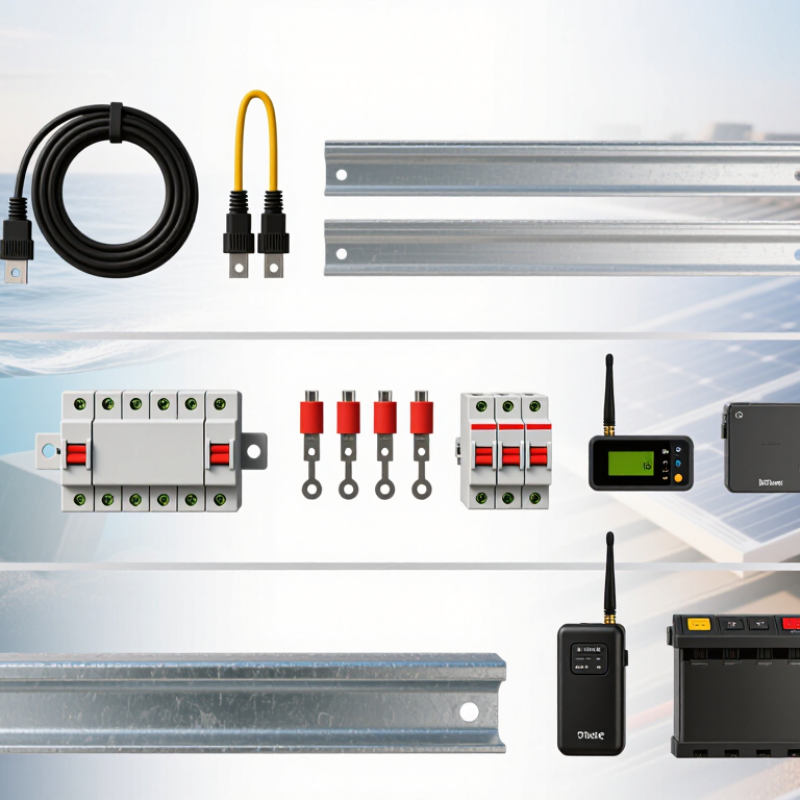
| Residential Rooftop | Sloped roof, limited installation area, nearby occupants, moderate wind exposure | Roof mounting system with flashed or approved rail attachment | Aluminum rails, stainless steel fasteners, certified roof attachments, adjustable end and mid clamps | Provides a stable, lightweight structure while reducing roof leakage risk and simplifying installation on common residential roof types. | Essential | Confirm roof material, rafter spacing, local wind and snow loads, and waterproofing details. |
| Residential Rooftop | Partial shading from chimneys, trees, neighboring buildings, or different roof orientations | Module-level power electronics | Module-level shutdown capability, monitoring, and voltage compatibility with the selected modules | Helps manage mismatch caused by shading or multiple roof orientations and can provide detailed system-level monitoring. | High | Check communication reliability, installation temperature range, and code requirements for rapid shutdown. |
| Commercial Flat Roof | Large membrane roof, low roof pitch, maintenance access requirements, possible ballast limitations | Low-tilt ballasted or mechanically attached mounting system | Aerodynamic design, protected roof-contact surfaces, defined ballast zones, and roof-load documentation | Supports fast installation across large roof areas while minimizing penetrations when the roof structure permits ballast. | Essential | Verify roof warranty, structural capacity, membrane compatibility, wind uplift, and required maintenance pathways. |
| Commercial Flat Roof | High rooftop equipment density, frequent service access, fire-separation constraints | Cable management and rooftop pathway system | UV-resistant clips, non-abrasive cable supports, elevated pathways, and clearly defined service corridors | Protects conductors from abrasion and standing water while keeping modules, drains, vents, and equipment accessible. | Essential | Avoid unsupported cable loops, sharp bends, blocked drains, and contact with hot roof surfaces. |
| Utility-Scale Ground Mount | Open land, long row lengths, high wind exposure, construction traffic, and large DC collection areas | Driven-pile or ground-screw racking system | Galvanized or corrosion-resistant steel, engineered pile embedment, torque or pull-out verification | Provides scalable support for long rows and can reduce concrete use and installation time when soil conditions are suitable. | Essential | Base selection on geotechnical testing, frost depth, corrosion category, wind loads, and tracker compatibility. |
| Utility-Scale Ground Mount | Uneven terrain, high module count, long DC runs, and centralized electrical collection | DC string combiner and monitoring equipment | Appropriately rated fuses, surge protection, disconnects, enclosure protection, and string-current monitoring | Consolidates multiple strings, supports fault isolation, and improves operational visibility across large solar fields. | Essential | Coordinate voltage, current, short-circuit ratings, environmental enclosure rating, and maintenance clearance. |
| Single-Axis Tracker Plant | Large open site, strict row-to-row shading control, wind stow requirements, moving mechanical components | Tracker controller, position sensors, and drive protection | Backtracking control, wind-stow logic, robust bearings, protected motors, and reliable communications | Improves energy yield by following the sun while reducing row shading and protecting the tracker during strong winds. | Essential | Evaluate slope tolerance, wind-stow strategy, emergency operation, spare parts, and communications redundancy. |
| Agrivoltaic Project | Active farmland, crop-management equipment, irrigation systems, variable row spacing, and possible livestock access | Elevated or wide-row mounting accessories | Increased clearance, reinforced posts, protected wiring, equipment access gaps, and adaptable row geometry | Allows agricultural activity to continue beneath or between arrays while protecting the PV system from farm operations. | High | Coordinate array height, crop light requirements, machinery dimensions, drainage, and electrical isolation. |
| Carport Solar | Vehicle circulation, limited construction space, drainage needs, public access, and exposure to vehicle impact | Water-managed carport structure and protected cable routing | Integrated gutters, corrosion-resistant steel or aluminum, impact-protected conduits, and adequate clearance | Combines solar generation with vehicle shelter while directing rainwater away from parking and pedestrian areas. | Essential | Confirm foundation design, clearance for vehicles, drainage discharge, lighting, signage, and accessibility requirements. |
| Coastal Solar Project | Salt spray, high humidity, strong wind, airborne sand, and accelerated metal corrosion | Marine-environment mounting hardware and sealed enclosures | Appropriate stainless steel or coated-metal components, compatible metals, sealed cable glands, and high corrosion resistance | Reduces corrosion-related failures and helps preserve structural integrity in salt-rich environments. | Essential | Prevent galvanic corrosion, avoid incompatible metal combinations, and use site-specific corrosion and wind assessments. |
| High-Snow Region | Heavy snow load, freeze-thaw cycles, drifting snow, and difficult winter maintenance | Heavy-load roof or ground mounting reinforcement | Engineered snow-load capacity, reinforced rails, sufficient attachment points, and raised cable routing | Maintains structural safety under snow accumulation and reduces the risk of cable damage from ice or drifting snow. | Essential | Use local ground and roof snow-load data; do not rely only on the module’s published mechanical load rating. |
| High-Wind or Hurricane Region | Extreme wind, uplift, flying debris, rapid weather changes, and possible post-storm inspection needs | Enhanced wind-rated racking and securement hardware | Site-engineered uplift resistance, reinforced clamps, robust attachments, and documented torque requirements | Improves resistance to uplift and dynamic loads when the complete array is engineered for the local wind environment. | Essential | Consider edge and corner zones, roof age, attachment spacing, wind-borne debris, and inspection procedures. |
| Desert Utility Plant | High solar irradiance, extreme heat, dust, sand, large temperature swings, and limited water availability | Dust-resistant cable protection and soiling-management accessories | UV-stable materials, high-temperature-rated connectors, sealed enclosures, dry-cleaning support, and robust cable clips | Helps reduce heat- and dust-related degradation while supporting maintenance strategies where water is scarce. | High | Use temperature-corrected electrical ratings and keep connectors off the ground and away from concentrated heat. |
| Agricultural or Livestock Site | Dust, ammonia, animal activity, irrigation, heavy equipment, and regular washdown operations | Protected conduit, equipment barriers, and corrosion-resistant fasteners | Chemical-resistant conduit, sealed junction boxes, elevated wiring, impact guards, and washdown-compatible materials | Protects electrical components from corrosive gases, moisture, animals, and accidental mechanical damage. | Essential | Separate electrical equipment from manure storage and wash areas; inspect conduit and bonding points regularly. |
| Floating Solar | Reservoir or quarry water, wave action, changing water levels, humidity, and difficult access | Floating pontoon, anchoring, and flexible electrical connection system | UV- and water-resistant floats, corrosion-resistant anchors, flexible joints, protected walkways, and buoyancy margin | Allows PV deployment on water while accommodating movement, water-level variation, and controlled access for inspection. | Essential | Assess water chemistry, wind and wave conditions, anchoring loads, environmental permits, and emergency access. |
| Battery-Integrated Solar Project | PV array connected to batteries, bidirectional power flow, thermal management requirements, and fire-safety controls | Battery disconnects, DC protection, energy-management communications, and fire-safety equipment | Correct interrupt rating, DC-rated isolation, monitoring of temperature and state of charge, and code-compliant enclosures | Supports safe isolation, coordinated charging and discharging, and reliable operation of the PV-plus-storage system. | Essential | Follow the battery system listing, installation manual, local electrical code, ventilation, clearance, and emergency-response requirements. |
| Remote Off-Grid System | Limited grid access, difficult transport, limited maintenance visits, and possible severe weather | Charge controller, remote monitoring, spare protection devices, and rugged cable assemblies | MPPT control, low standby consumption, environmental protection, data logging, and replaceable field components | Improves energy harvest and allows faults or low battery conditions to be identified without frequent site visits. | Essential | Size for peak load, battery voltage, temperature, future expansion, communications availability, and local service capability. |
| Lightning-Prone or Rural Site | Long cable routes, exposed terrain, overhead infrastructure, thunderstorms, and weak utility networks | Surge protective devices, grounding, and equipotential bonding components | DC and AC surge protection coordinated with system voltage, correctly sized grounding conductors, and bonded metallic structures | Reduces damage from transient overvoltage and helps maintain a controlled electrical potential across the installation. | Essential | Design protection as a coordinated system and follow local grounding, bonding, and lightning-protection requirements. |
| Large Commercial or Utility Project | Multiple inverters, long-term operation, remote supervision, and performance-guarantee requirements | Plant monitoring, weather sensors, and energy-metering equipment | Irradiance, module temperature, ambient temperature, wind measurement, revenue-grade metering, and alarm reporting | Supports performance analysis, fault detection, yield verification, and maintenance planning over the project life. | High | Define data ownership, sensor calibration, communication protocols, cybersecurity, and data-retention requirements. |
| Any Grid-Connected PV Project | Local utility interconnection requirements, DC arc risk, maintenance isolation, and changing operating conditions | DC isolators, AC disconnects, fuses, and clearly labeled safety equipment | Voltage and current ratings exceeding calculated operating values, suitable interrupt ratings, lockable handles, and durable labels | Enables safe maintenance and fault isolation while supporting compliance with electrical and interconnection requirements. | Essential | Coordinate device ratings with maximum system voltage, short-circuit current, temperature, and conductor ampacity. |
| Any PV Project | Long service life, multiple material interfaces, routine inspection, and potential future replacement | Grounding, bonding, identification, and service documentation accessories | Listed bonding hardware, corrosion-compatible conductors, UV-resistant labels, circuit directories, and as-built records | Improves electrical continuity, troubleshooting, inspection efficiency, and safe operation throughout the system life. | Essential | Document torque values, cable routes, protective-device locations, test results, and equipment replacement procedures. |